
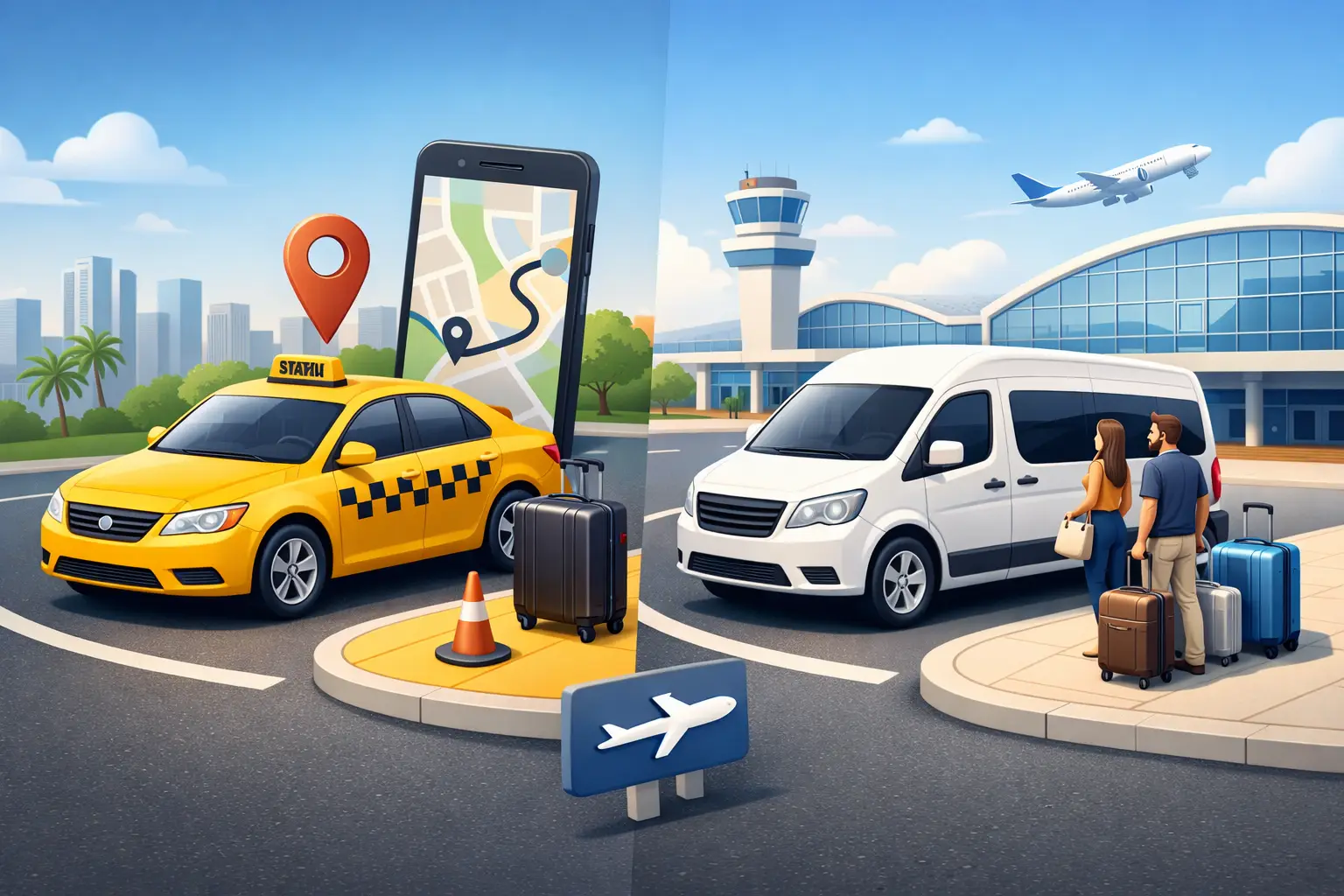
You land after a long flight, clear baggage claim, and now the real question starts: taxi or airport transfer? For many travelers, this is less about transportation and more about how much uncertainty they are willing to deal with after arrival.
If all you need is a quick ride and you are comfortable figuring things out on the spot, a taxi can work. If you want your pickup arranged in advance, your price clear before travel, and your driver coordinated around your arrival time, an airport transfer is usually the better fit. The right choice depends on how you travel, when you arrive, and how much predictability matters to you.
Taxi or airport transfer: what is the difference?
A taxi is typically an on-demand ride. You get one at a taxi stand, hail one on the street where available, or request one close to the time you need it. That works well for short notice travel and simple city trips.
An airport transfer is usually pre-booked. You enter your trip details ahead of time, confirm the pickup, and know what service to expect before you leave home. For airport arrivals, that often includes driver coordination, a planned meeting point, and support if your flight schedule changes.
That difference matters more than it seems. A taxi gets you a car. A pre-booked airport transfer gets you a process.
When a taxi makes sense
There are plenty of situations where a standard taxi is a reasonable option. If you are traveling light, arriving during normal daytime hours, and going to a straightforward central location, a taxi may be enough. It is also practical if your plans are flexible and you do not mind waiting in line or checking the fare as you go.
Some travelers prefer taxis because they feel informal and immediate. You land, join the queue, and leave. If there is no language barrier, no unusual luggage, and no concern about timing, this can be perfectly fine.
But that convenience has limits. You may not know exactly how long the wait will be, who your driver will be, or what the final ride experience will look like until the trip starts. For some people, that is acceptable. For others, especially after an international flight, it adds stress at the worst time.
The trade-off with on-demand rides
The main advantage of a taxi is flexibility in the moment. The main downside is uncertainty in the moment. If demand is high, weather is poor, or several flights land close together, pickup may take longer than expected.
Cost can also feel less predictable to visitors. Even where fares are regulated, travelers often prefer knowing the total before they arrive, especially when budgeting for a family trip or business schedule.
When an airport transfer is the better choice
An airport transfer is often the stronger option when your priority is reliability. If you are arriving in an unfamiliar city, traveling with children, carrying multiple bags, or landing late at night, a pre-arranged service removes several common pain points at once.
You know your ride has been booked. You know where the pickup should happen. You usually know what is included in the price. That matters if you are trying to avoid surprises after a long flight.
For airport pickups, the best transfer services also account for delays. Flight tracking, waiting time policies, and clear pickup instructions can make a real difference when your arrival does not go exactly as planned. That kind of coordination is hard to replace with a last-minute decision outside the terminal.
Why pre-booking changes the experience
Pre-booking does not just save time. It changes the tone of the arrival. Instead of deciding what to do after landing, you are following a plan already in place.
That can be especially useful for English-speaking visitors arriving abroad. If you have already entered your destination, confirmed your ride, and received instructions in advance, there is less room for confusion. You are not comparing options curbside while tired, checking whether the fare seems right, or hoping the next available car fits your group and luggage.
Cost: cheaper is not always simpler
Many travelers start with price, which is fair. But comparing a taxi and an airport transfer only by the lowest possible fare can be misleading.
A taxi may cost less in some situations, especially for a short and uncomplicated route during quiet periods. But the lower headline cost does not always reflect the full travel experience. Waiting time, route uncertainty, demand conditions, and add-on charges can affect how the trip feels and what you actually pay.
An airport transfer often gives you a confirmed price in advance, with taxes, fees, and tolls included where stated. That does not guarantee it will always be the cheapest option. It does mean you can make the decision with more information.
For many travelers, especially families or business passengers, that clarity is worth paying for. It is easier to manage a trip when the transportation cost is settled before departure rather than calculated while you are already in motion.
Reliability matters most at the airport
The airport is where weak transport plans show up fast. A small delay can turn into a missed meeting, a difficult hotel check-in, or a stressful start to a vacation.
That is why airport transport should be judged less by theory and more by execution. Who is monitoring the booking? What happens if the flight is late? How are meeting instructions shared? Is there support if something changes?
A standard taxi system is built for availability. A good airport transfer service is built for coordination. Neither model is automatically better in every situation, but airport arrivals tend to reward planning.
For families, groups, and business travelers
The more complex your trip, the more useful a transfer becomes. Families often need space for strollers and extra bags. Groups need a vehicle that fits everyone without splitting up. Business travelers usually care about punctuality and a smooth handoff more than saving a small amount on the fare.
In those cases, the issue is not just getting a ride. It is getting the right ride at the right time, with fewer decisions left for arrival.
What to check before you book either one
If you are deciding between a taxi or airport transfer, focus on the details that affect real travel conditions.
First, think about your arrival time. A midday arrival is different from a late-night landing. Next, consider your group. One person with a carry-on has more flexibility than a family of four with checked bags. Then consider your tolerance for uncertainty. Some travelers do not mind improvising. Others want each step confirmed ahead of time.
It also helps to check what is included. With a transfer, look for pickup instructions, waiting policy, total pricing, and whether flight monitoring is part of the service. With a taxi, understand how fares are calculated and what the pickup process will likely be at the airport you are using.
Which option is better in Porto?
For travelers arriving in Porto, the choice often comes down to how you want the first part of your trip to feel. If you are comfortable arranging transportation on arrival and your plans are simple, a taxi may do the job. If you want a more controlled arrival with pre-booked details, fixed service expectations, and clearer coordination, an airport transfer is often the safer option.
That is why many visitors choose to reserve ahead with a service focused on airport pickups rather than rely on whatever is available after landing. Companies such as Luso Taxis are built around that pre-arranged model, which appeals to travelers who want less guesswork and more structure.
The better question is not which is best
The better question is which one fits your trip.
A taxi suits travelers who value immediate availability and do not mind some variability. An airport transfer suits travelers who want planning, clarity, and support built into the ride. Neither option is automatically right every time, but they solve different problems.
If your priority is simply getting from the airport to your destination, both can work. If your priority is starting the trip with fewer unknowns, the answer usually becomes much clearer before you even board the plane.