LUSO TAXIS BLOG
10 Best Ways to Avoid Taxi Scams
19/06/2026
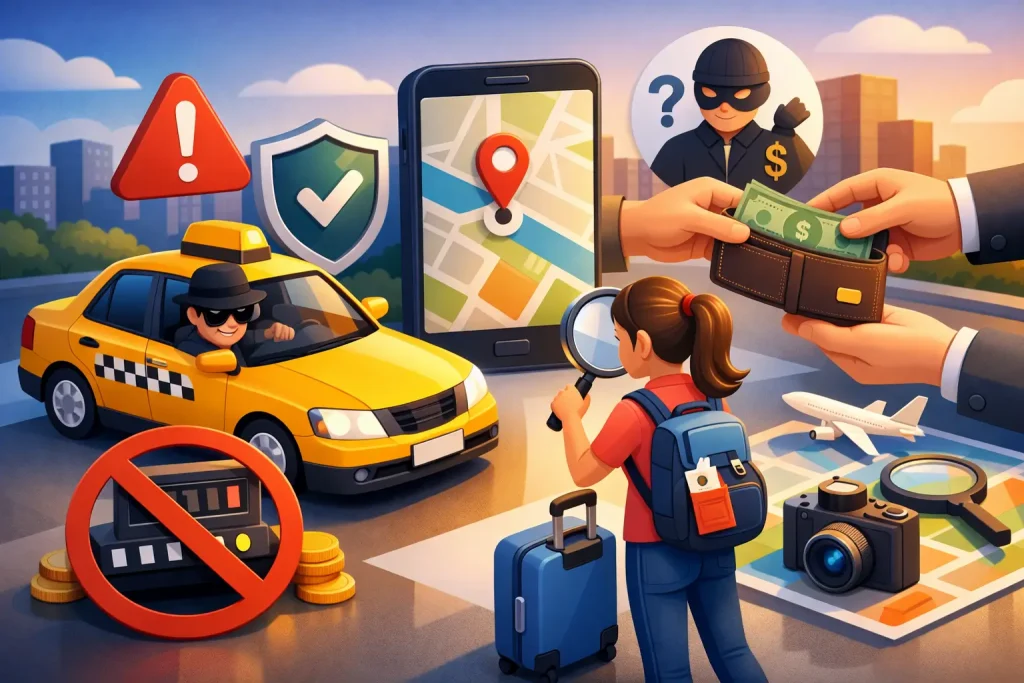
Landing in an unfamiliar city is when bad taxi experiences usually happen – not because travelers are careless, but because they are tired, rushed, and trying to get moving. The best ways to avoid taxi scams start before you ever step into a car. A few simple checks can protect your time, money, and peace of mind, especially after a long flight or late arrival.
For most travelers, the real issue is not one dramatic scam. It is small pressure points that add up fast: unclear pricing, drivers refusing meters, route stretching, fake extra fees, or pickups that feel disorganized from the start. The good news is that these problems are usually avoidable if you know what to look for.
Why taxi scams still catch smart travelers
Taxi scams work because they target moments when people have the least information. At airports, train stations, and busy tourist areas, visitors often do not know the normal fare, the expected route, or what local taxi procedures look like. That gap creates room for confusion, and confusion is where overcharging starts.
Not every bad ride is a scam, and that distinction matters. Heavy traffic, late-night surcharges, toll roads, or airport pickup fees can be legitimate depending on the city. The problem is when the passenger is not told clearly in advance, or when a real fee becomes an excuse to add questionable charges. That is why clarity matters more than guesswork.
Best ways to avoid taxi scams before your trip
The safest ride is usually the one arranged before you arrive. If you pre-book, you know who is meeting you, what the pickup process is, and what the trip is supposed to cost. That removes the most common pressure point: negotiating transportation while standing outside an airport with luggage.
A little preparation goes a long way. Check the standard route from the airport to your hotel. Look up whether local taxis usually use meters, fixed airport rates, or booking-based pricing. Save your destination address exactly as written, preferably in the local format as well as in English. When a driver sees that you know where you are going and how transport typically works, the chance of problems drops quickly.
Screenshots also help more than people expect. Save your reservation details, address, and any fare estimate on your phone so you are not dependent on airport Wi-Fi or a weak signal after landing.
Use official pickup points and verified services
One of the simplest ways to reduce risk is to ignore anyone approaching you inside the terminal or just outside the exit offering a ride. Legitimate drivers generally work from designated pickup points or pre-arranged bookings. Unsolicited offers can lead to unlicensed vehicles, inflated prices, or confusion about where you are being taken.
If you are using a taxi rank, make sure it is the official one. If you are booking a transfer, confirm the vehicle details, meeting instructions, and whether the driver will be holding a sign. A dependable service should be able to tell you exactly what happens after arrival, including what to do if your flight is delayed.
This is one area where pre-booked transfers often make sense for airport travel. The trade-off is that street taxis can be fine for spontaneous short trips, but for arrivals, the value of a fixed process is hard to overstate. Less uncertainty usually means fewer opportunities for overcharging.
Confirm the fare structure before the ride starts
Many travelers ask, “How much will it cost?” but the better question is, “How is this fare calculated?” That small change gets to the heart of the issue.
If the ride is metered, the driver should say so clearly and start the meter at the beginning of the trip. If the fare is fixed, agree on the amount before the car moves. If there are possible extras such as tolls, airport fees, waiting time, or late-night charges, ask about them upfront. A legitimate driver should be able to explain the pricing simply.
Vague answers are a warning sign. So is a driver who says the meter is broken, then offers a price that feels high but pressures you to accept it quickly. In that situation, it is usually better to step away and choose another vehicle.
Watch for route manipulation without becoming confrontational
You do not need to act like a local to protect yourself. Open a maps app, check the general direction, and pay attention to whether the route makes basic sense. You are not trying to challenge every turn. You just want to avoid the obvious problem: a ride that becomes much longer than necessary.
Some detours are legitimate. Traffic, construction, road closures, and one-way systems can all affect the route. But if the driver is taking you in a direction that clearly does not fit the destination, ask calmly, “Is this the fastest route today?” That gives them room to explain while signaling that you are paying attention.
Most issues stop there. If the answer is evasive or defensive, that tells you something. Staying calm works better than escalating. You want to reduce the chance of conflict while making it clear you are alert.
Be careful with cash, card issues, and change
Payment is another common moment for problems. Some drivers claim the card machine is not working after the ride is over, hoping the passenger has to scramble for cash. Others say they do not have change for large bills and push the rider to overpay.
The fix is simple. Before departure, confirm how payment will work. If you plan to pay by card, ask if card payment is available and working. If you are paying cash, carry smaller notes when possible. Count your money before handing it over, and wait for the receipt if one is expected.
If a driver suddenly changes the payment terms at the end, push back politely but clearly. Surprises at payment time are one of the oldest tricks in the book.
Do not hand over control of your luggage too quickly
Most drivers will help with bags appropriately, but travelers should still stay aware. A common pressure tactic is to put luggage in the trunk immediately, creating a sense that the ride is already underway before pricing or destination details are confirmed.
It is better to settle the basics first: destination, fare structure, and payment method. Then load your bags. If anything feels off, you can walk away without the awkwardness of trying to retrieve luggage from a trunk while being pressured to continue.
This matters even more for families, older travelers, and anyone arriving with multiple suitcases. The more dependent you feel on the vehicle in that moment, the easier it is for a dishonest driver to create urgency.
Know the red flags that justify saying no
Travelers sometimes worry about seeming rude. In practice, a polite no is often the smartest move. If the driver refuses to explain the fare, discourages questions, will not use the agreed pricing method, or pressures you to get in immediately, that is enough reason to leave.
Other warning signs include missing identification, unofficial pickup behavior, or claims that all other transport options are unavailable. Scammers often try to narrow your choices quickly. The goal is to make you feel like this ride is the only practical option when it is not.
A dependable service should make the process easier, not more confusing.
Why pre-booking is often the safest option
Among the best ways to avoid taxi scams, pre-booking stands out because it removes uncertainty at every stage. You know the provider, the trip details, the pickup process, and the expected cost structure before the journey begins. That is especially useful for airport transfers, late arrivals, business trips, and family travel.
This does not mean every street taxi is risky. Many are completely legitimate. But when you compare the two options, pre-booking usually gives travelers more control. It is easier to verify the service, easier to coordinate delays, and easier to avoid disputes about rates or route choices.
For visitors arriving in Porto, for example, a pre-arranged airport transfer can be a practical way to avoid confusion right after landing. Services such as Luso Taxis focus on clear booking details, scheduled pickup coordination, and upfront trip information, which is exactly what reduces stress in unfamiliar surroundings.
What to do if you think you are being scammed
If you are already in the vehicle and something feels wrong, prioritize safety over winning an argument. Stay calm, keep your phone accessible, and document what you can: vehicle details, driver identification, route, and payment information. If needed, ask to stop in a busy public area.
If the issue is an inflated fare, request a receipt and take note of the location and time. If you booked through a company or platform, report the problem through official support channels as soon as possible. If the driver becomes aggressive or threatening, leave the situation and contact local authorities.
The goal is not to handle everything perfectly in the moment. It is to reduce your exposure and preserve enough information to report the issue afterward.
A good ride should feel predictable. You should know who is picking you up, where you are going, how the fare works, and what happens if plans change. When those basics are clear, taxi scams become much harder to pull off – and travel gets a lot simpler.