LUSO TAXIS BLOG
Private Transfer vs Public Transport
23/06/2026
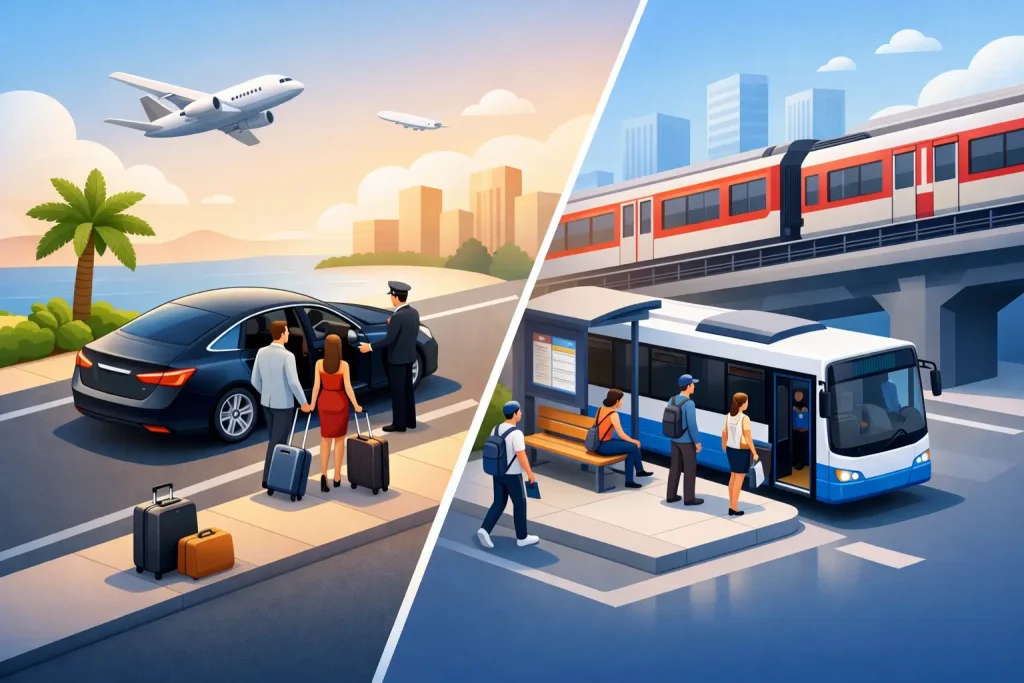
Landing after a long flight is when the choice between private transfer vs public transport stops being theoretical. If you are carrying luggage, arriving late, traveling with family, or heading to an unfamiliar address, the difference shows up fast. What looks cheaper on paper can become slower, more tiring, and harder to manage once you are on the ground.
That does not mean one option is always better. Public transportation can be efficient and cost-effective, especially for solo travelers with light bags and flexible schedules. A private transfer, on the other hand, is built for predictability. The right choice depends on what matters most for that specific trip: price, timing, comfort, simplicity, or peace of mind.
Private transfer vs public transport: what changes in real travel
The biggest difference is not just the vehicle. It is how much coordination you have to do yourself.
With public transportation, you usually handle each step on your own. That may include finding the right stop, checking schedules, buying tickets, watching for delays, and possibly changing lines. For experienced travelers, that may be routine. For someone arriving in a new city after a flight, it can feel like one more task when energy is already low.
A private transfer is more direct. Your pickup is arranged in advance, your route is planned, and the trip is built around your arrival time rather than the other way around. That matters most when timing is tight, when you are landing at night, or when you simply do not want the first hour of your trip to become a logistics exercise.
Cost matters, but so does the full cost of the trip
Public transport usually wins on lowest upfront price. If you are traveling alone and your hotel is near a train, metro, or bus stop, it can be the most economical option. That is especially true during daytime hours when service is frequent and easy to follow.
But the cheapest fare is not always the lowest total cost. If public transport requires multiple tickets, a longer route, or a final taxi for the last stretch, the savings can shrink quickly. The same applies if your group is large enough that several tickets add up close to the cost of a pre-booked car.
Private transfers tend to cost more than a bus or metro ticket, but they also offer more pricing clarity. When the service is properly structured, the fare is known in advance and includes the core trip details, which helps travelers avoid uncertainty after arrival. For many people, especially those booking from abroad, knowing the final transportation cost before the trip is part of the value.
Time is where the gap often gets wider
If your route is simple and well served, public transportation can be perfectly reasonable. But if your destination is outside the city center, if you are arriving during off-hours, or if you need to make connections, travel time can expand fast.
A private transfer is usually the most direct option from pickup to destination. There is no waiting on a platform with bags, no transfer between lines, and no need to figure out whether the stop you need is still several blocks away. For business travelers, families with children, or anyone heading straight to a hotel after a long journey, that time difference often matters more than the fare difference.
Airport arrivals are a good example. On paper, public transit from an airport may look simple. In practice, it depends on when you land, how long baggage claim takes, whether your flight is delayed, and how comfortable you are navigating the system on arrival. A pre-arranged transfer removes most of those variables.
Comfort is not a luxury issue
Comfort sounds optional until you are managing two suitcases, a stroller, or a tired child. Then it becomes practical.
Public transportation works best when you can move easily, stand if needed, and keep up with the pace of the system. If the vehicle is crowded or the walk between stops and your destination is longer than expected, the trip can feel much harder than it looked when you booked the flight.
A private transfer is simply easier to manage. You get door-to-door transportation, dedicated luggage space, and a quieter ride. That is not about luxury branding. It is about reducing friction at the exact point in the trip where most travelers want things to be straightforward.
This is especially relevant for older travelers, families, couples carrying multiple bags, and visitors arriving in a city they do not know well. Comfort, in that case, is closely tied to control and energy.
Reliability depends on your situation
Public transportation is reliable in the sense that routes and schedules are established. But that reliability is system-based, not personalized. If your flight lands late, if a line is disrupted, or if your arrival falls outside normal service hours, you are the one adjusting the plan.
Private transfers are built around the passenger. That is why they tend to work well for airport pickups and other fixed-time journeys. Services that include flight tracking, clear pickup instructions, and waiting time can reduce the stress that comes with delays or unexpected changes.
This is one reason many travelers prefer to pre-book rather than make decisions after landing. They want to know who is meeting them, where pickup happens, and what happens if the flight does not arrive exactly on schedule. In a place like Porto, where many visitors are arriving for the first time, that kind of coordination can make the start of the trip much easier.
Private transfer vs public transport for different types of travelers
A solo traveler with one backpack and a flexible schedule may be completely fine using public transportation. If the hotel is centrally located and arrival is during regular operating hours, it can be a sensible choice.
A couple on a short city break may see things differently. If they are arriving after a long flight and want to go straight to their hotel without figuring out stops, tickets, and directions, a private transfer may feel worth the extra cost.
Families usually notice the trade-offs more quickly. Children, car seats, extra luggage, and fatigue change the equation. What works for one adult with a carry-on often does not work as smoothly for a family of four.
Business travelers also tend to value predictability over the lowest fare. A missed connection or delayed arrival at a meeting carries a cost that is bigger than the transport ticket itself.
Then there are travelers arriving late at night or very early in the morning. In those cases, the question is often less about preference and more about practicality. Public transportation may be limited, while a pre-booked ride remains straightforward.
When public transport makes sense
Public transportation is a good fit when your trip is simple. You are traveling light, arriving at a convenient time, staying near a major route, and comfortable handling your own navigation. It also makes sense when budget is the top priority and you do not mind a little extra effort.
It can also be a good choice for travelers who know the city already. Familiarity changes a lot. If you know the stops, the ticket system, and the walking distance to your destination, public transit can feel easy rather than demanding.
When a private transfer is the better option
A private transfer makes more sense when the trip has more moving parts. You are arriving with luggage, landing late, traveling with children, going to a less central location, or simply wanting a clear plan from airport to accommodation.
It is also a better fit when communication and coordination matter. Travelers booking from the US or other countries often want to arrange transport before departure, understand the full price in advance, and avoid negotiating details after arrival. That is exactly where a structured transfer service adds value.
Companies such as Luso Taxis are built around that kind of trip planning: pre-booked rides, clear pickup coordination, fixed service expectations, and support when timing changes. For travelers who want dependable transport rather than guesswork, that approach answers a real need.
The right choice is the one that removes the biggest problem
If your biggest concern is keeping costs low, public transportation may be the right answer. If your biggest concern is arriving without delays, confusion, or extra effort, a private transfer is often the stronger option.
The best travel decisions are not made in the abstract. They are made around real conditions: how many people are traveling, how much luggage is involved, what time you arrive, and how much uncertainty you are willing to manage. Choose the option that makes the hardest part of the journey easier, not just the one that looks cheapest before the trip begins.