LUSO TAXIS BLOG
Uber or Taxi in Porto? What to Choose
14/05/2026
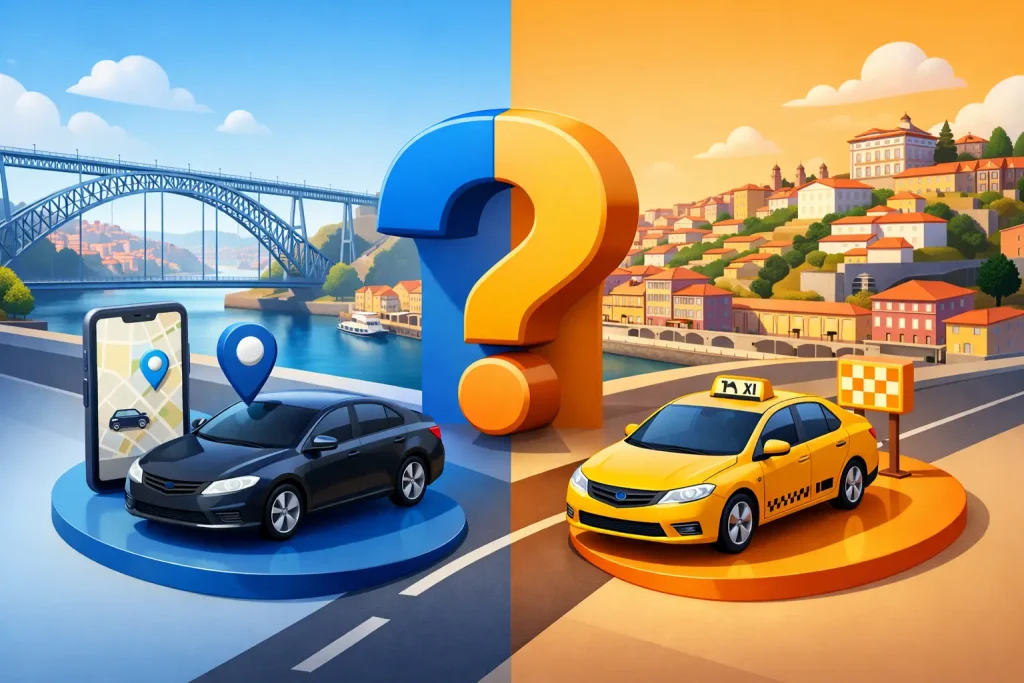
If you are deciding between uber or taxi in Porto right after landing, the best option usually comes down to one thing: how much uncertainty you are willing to deal with. Some travelers are fine opening an app and waiting to see what happens. Others want a driver confirmed in advance, a clear pickup plan, and no guesswork after a long flight.
That difference matters more than people expect. Porto is easy to enjoy, but arrival logistics can still be stressful when you are carrying bags, traveling with family, landing late, or trying to get across the city on a schedule. In those moments, the cheapest option is not always the easiest one, and the fastest option is not always the most dependable.
Uber or taxi in Porto: the real difference
On paper, Uber and taxis solve the same problem. They get you from one place to another. In practice, the experience can feel quite different depending on when and where you need the ride.
Uber is built around on-demand availability. You request a ride through the app, see an estimated fare, and wait for a driver to accept. That works well when demand is normal, your phone has service, and you can comfortably wait at the pickup point.
A standard taxi is more immediate if one is already available nearby or at a taxi stand. In busy areas, that can be convenient. But the experience may vary depending on queue length, timing, language comfort, and whether you are trying to calculate total cost while moving through an unfamiliar city.
There is also a third option travelers often overlook: a pre-booked transfer. This is different from both a street taxi and an on-demand app ride because the trip is arranged before you need it. For airport arrivals, early departures, business appointments, or family travel, that extra structure often makes the trip easier.
Price is important, but not the whole decision
Many people start with cost, and that makes sense. Uber is often seen as the lower-cost choice, especially for short city rides during off-peak hours. Taxis may feel more predictable to some travelers because they are a familiar local service, but the final fare can depend on distance, traffic, and applicable extras.
The problem is that price comparisons are rarely static. Uber uses demand-based pricing, so the fare can jump during busy periods, bad weather, weekends, or major arrival waves. Taxis can also become less appealing if you are unsure about wait time, route, or add-on charges. A ride that looked cheaper at first can end up costing more in time or stress.
For many visitors, the better question is not simply Which is cheaper? It is Which option gives me the clearest total cost before I travel? If you value that clarity, a pre-arranged car service with transparent pricing can be more useful than either guessing at a taxi meter or watching an app price change by the minute.
Airport rides are where the differences show up fast
If your trip starts at the airport, this is where choosing between Uber or taxi in Porto becomes less theoretical. After a flight, people are usually tired, checking messages, watching for baggage, and trying to move quickly. That is not the ideal time to troubleshoot pickup instructions.
With Uber, you may need to confirm the designated pickup zone, wait for a driver to accept, and coordinate your exact location. Sometimes that is simple. Sometimes it is not, especially if airport traffic is heavy or your phone battery is low.
With a regular taxi, you can usually head to the official taxi area and take the next available car. That can work well, but queue length and timing matter. During peak periods, the line may move slower than expected.
With a pre-booked airport transfer, the process is usually more structured. Your ride is assigned in advance, flight timing can be monitored, and the pickup plan is clear before you land. For travelers arriving from abroad, that often removes the most stressful part of the journey.
Reliability depends on your trip type
If you are going from a hotel to dinner in the city center, Uber or a taxi may both be perfectly fine. The ride is short, the timing is flexible, and a small delay probably does not matter much.
But not every trip is low-stakes. If you need to reach the airport before dawn, attend a meeting at a fixed time, or travel with children and luggage, reliability becomes the main issue. You are no longer just buying transportation. You are buying confidence that the ride will happen when you need it.
That is where on-demand transport can feel less certain. A car might be nearby, or it might not. A taxi might be easy to find, or it might require waiting. In contrast, pre-booked transport is designed around commitment to a planned pickup time. That matters when your margin for delay is small.
Convenience is different from simplicity
People often call app rides convenient, and they are – when everything lines up. But convenience for a local resident is not always the same as simplicity for a traveler.
A visitor may not have mobile data working immediately. They may not understand the pickup layout. They may be arriving with older relatives, children, or several bags. In that context, a ride that depends on app coordination can feel more complicated than expected.
A regular taxi removes the app issue, but it does not always remove uncertainty. You still need to find the right stand, judge the line, and manage the trip on the spot.
Pre-booked service is usually simplest when you want the details settled before travel. You know who is coming, when they are coming, and what the pickup procedure is. For many visitors, especially English-speaking travelers arranging transport from abroad, that is the difference between a smooth arrival and a fragmented one.
Safety and communication matter more at night
Late-night arrivals and early-morning departures change the calculation. At those hours, travelers tend to care less about saving a small amount and more about feeling secure, getting clear instructions, and not waiting outside longer than necessary.
Uber provides driver details in the app, which many passengers appreciate. Licensed taxis offer the reassurance of a regulated local service. Both can be suitable options.
Still, if communication is a concern, or if you want a clearer chain of support, a pre-arranged transfer often feels more stable. You are not just hoping a nearby car will appear. You have a booked service, a known pickup arrangement, and a clearer path if your flight is delayed or your arrival time changes.
When Uber makes sense
Uber is a reasonable choice if your schedule is flexible, you have working mobile service, and you are traveling light. It can also make sense for short urban trips when you do not mind waiting a few minutes and you are comfortable navigating pickup points through the app.
For solo travelers with no tight schedule, that flexibility can be enough. If the app fare looks good and a driver is close, it may be the simplest option in that moment.
When a standard taxi makes sense
A taxi can be the practical choice when you see one readily available and want to leave immediately. If you are already in a central area, near a hotel, station, or taxi stand, it may be faster than opening an app and waiting for acceptance.
This works best when you are not trying to solve a more complicated travel need. For straightforward point-to-point city trips, taxis remain a useful option.
When a pre-booked transfer is the better fit
If your ride involves the airport, a fixed schedule, extra luggage, family members, or any situation where delays create problems, booking ahead is usually the safer decision. The value is not just the ride itself. It is the reduced friction.
That is why many travelers choose services built around advance coordination. Features such as flight tracking, Meet and Greet, fixed included pricing, and waiting time policies make the process clearer from the start. A company like Luso Taxis is designed for that type of traveler – someone who would rather confirm the trip in advance than improvise after arrival.
So, should you choose Uber or taxi in Porto?
If your trip is casual and flexible, either can work. Uber may suit travelers who prefer app-based booking and are comfortable with variable timing. A taxi may suit travelers who want the next available local car without using an app.
But if your priority is dependable pickup, clear pricing, airport coordination, and less uncertainty, neither option is always the best answer. A pre-booked transfer often gives you more control over the part of travel that goes wrong most often: the handoff between arrival and getting where you actually need to be.
The easiest ride is usually the one you do not have to figure out on the curb.